WHO - Health Emergencies Management Suite (HEMS) Enhancements
In late 2024 the World Health Organization engaged Relief Applications to enhance its Health Emergencies Management Suite (HEMS) Application Builder, adding the features needed to replace the legacy Event Information Site (EIS) and migrate standalone applications into a single cohesive ecosystem covering the end-to-end lifecycle of public-health events.
- Client
- WHO
- When
- Oct–Dec 2024
- Team
- 5+
- Services
- Info management & MEAL, App development
- Technologies
- Angular, Node.js, GraphQL, Docker, MongoDB, Azure
- Industry
- Public health emergencies, Digital health
- SDGs
- 3. Good health and well-being, 9. Industry, innovation and infrastructure, 17. Partnerships for the goals
- Client website
- who.int
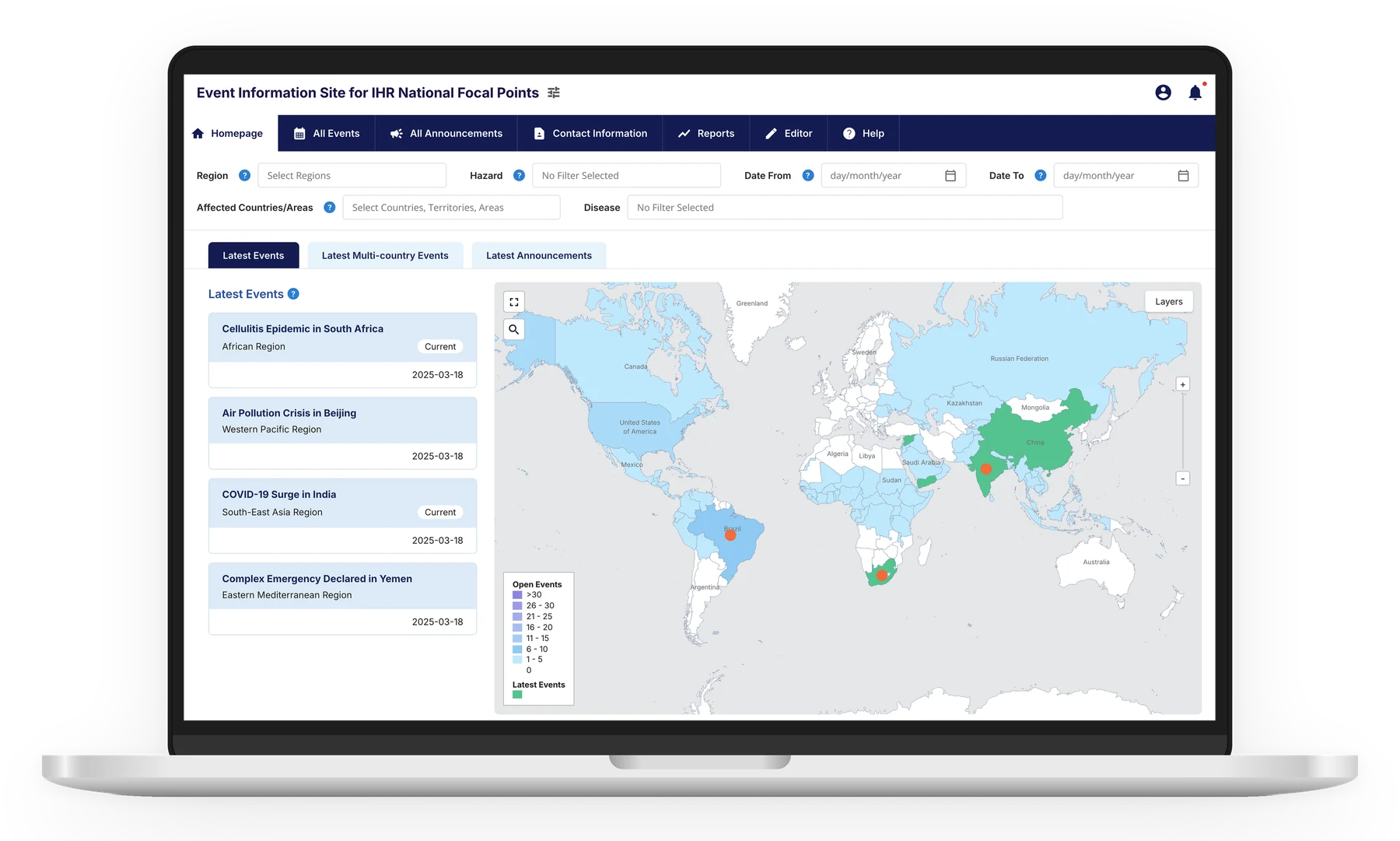
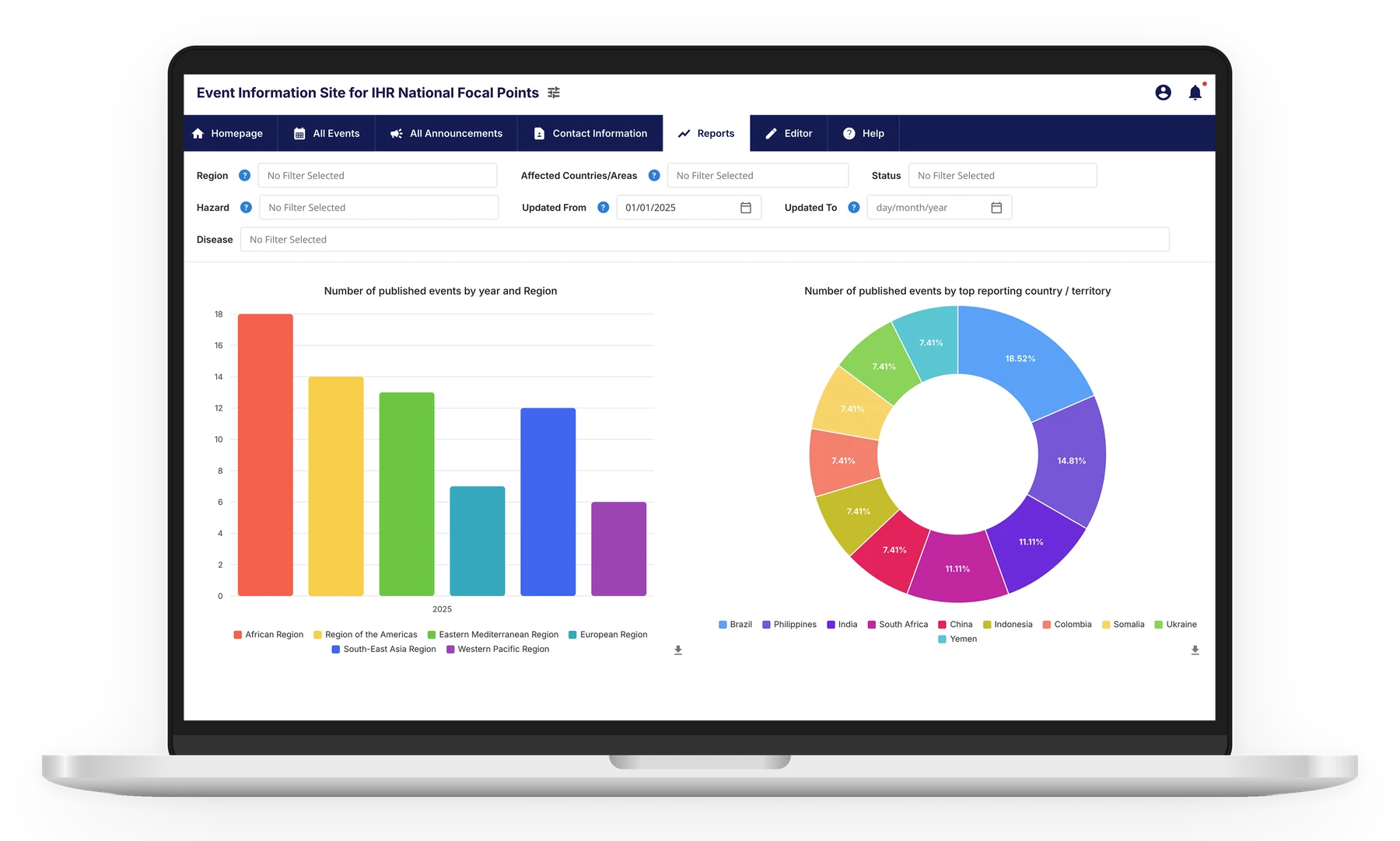
WHO engaged us to extend the HEMS Application Builder with the advanced features needed to fully replace the Event Information Site (EIS), enabling faster, more actionable information flows across levels of the organization during public-health emergencies. HEMS consolidates emergency-management apps into a cohesive ecosystem covering detection, response, and recovery. Replacing a legacy, widely used system like EIS required feature parity plus UX and workflow upgrades to reduce time-to-publish and improve data consistency for incident management. We coordinated closely with WHO via Azure DevOps, delivering enhancements in short iterations with documented acceptance criteria. The solution followed an n-tier architecture, CI/CD via GitHub, and secure hosting in Azure. We emphasized editor usability (WYSIWYG), robust API contracts, and role-based workflows to keep publishing reliable under pressure. We delivered:
EMS API integrations (events, bulletins, NFP contacts) Document-management integration User stats (usage/engagement insights) Custom action buttons to publish events Map component on event detail dashboards WYSIWYG editor for form/content usability Related bulletins & announcements tab Views for pending/unpublished items
This project demonstrates Relief Applications' rapid enhancement of a large-scale health emergency platform, complex API integration, editor-first UX, and DevOps discipline.
The challenge
- Ensuring continuity while replacing a mission-critical legacy (EIS)
- Aligning with WHO governance, security and data standards
- Integrating multiple services & APIs at scale
- Optimizing editor workflows for rapid, low-error publishing
- Maintaining performance and auditability.
What we did
- Iterative delivery with clear acceptance criteria in DevOps
- API-contract mapping and role-based permissions
- WYSIWYG editor improvements + standardized publishing actions
- Optimized queries & CI/CD pipelines for reliability and speed
- Built-in user stats and event-level mapping for situational awareness.
More projects
- MSF UK - REMIT: Research Management & Impact Tool Review: MSF UK
- Equality Fund - Impact Library: Data, Stories & Insights: Equality Fund
- HQAI - Innovation & IT Advice: HQAI
- WHO - Global Health Cluster Support: WHO
- FIDH - Automated Timesheet Management System: FIDH
- UNESCO - MAB Biosphere Reserves Platform: UNESCO